

The Foundation of Tatreez: Tools, Fabric & the Peeling Technique
September 29, 2026
3 – The Foundation of Tatreez: Tools, Fabric & the Peeling Technique
September 29, 2026
Every Tatreez piece begins with a strong foundation. The fabric, needle, thread, and preparation techniques all play an important role in creating the precise geometric patterns that define Palestinian embroidery. At Tatreez Designs, we believe that understanding these foundations helps us appreciate not only how Tatreez is made, but also the skill, patience, and tradition behind every piece.
Tatreez requires only a few essential tools:
- Even-weave fabric – A fabric with clearly visible horizontal and vertical threads makes counting easier.
- Embroidery needle – Choose a needle suitable for your fabric and thread.
- Embroidery thread – Traditionally, Tatreez is known for its vibrant colors and carefully worked stitches.
- Small scissors – Useful for trimming threads and preparing the fabric.
- Tatreez pattern – A counted chart or motif provides the guide for your design.
Choosing the Right Fabric
Because Tatreez is a counted-thread embroidery technique, the structure of the fabric is essential. An even-weave fabric has horizontal and vertical threads that are relatively uniform in size and spacing. This allows the embroiderer to count the threads and position each stitch accurately. Cotton and linen are commonly used choices, depending on the project and desired finish. Before stitching, the fabric should be clean, smooth, and properly sized for the design.
What Is the Peeling Technique?
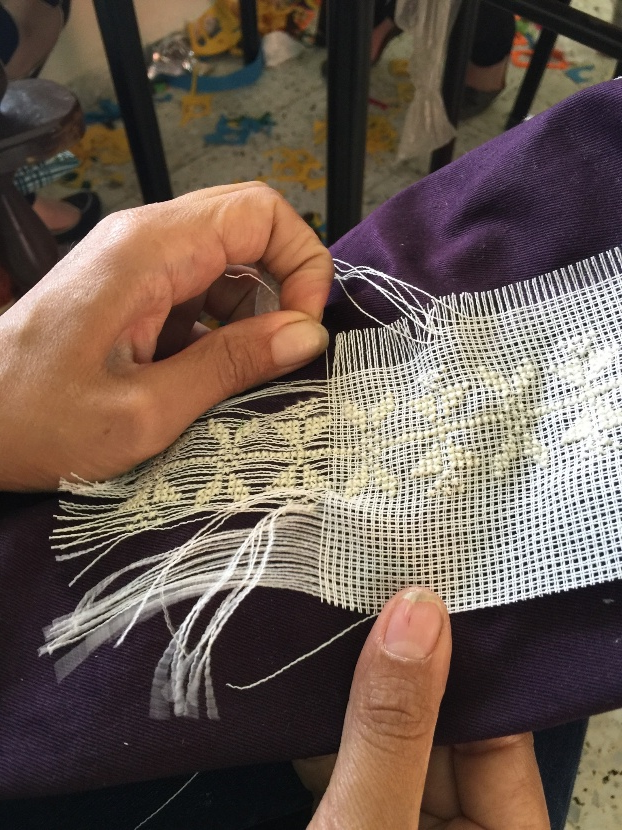
In some Tatreez preparation methods, peeling refers to carefully removing selected threads from the fabric to create a visible guide for counted embroidery. This technique is particularly useful when working on a fabric where the weave is not immediately easy to count. By removing specific threads, the embroiderer can create a subtle grid or reference point that helps with stitch placement.
The process requires patience and precision:
1. Identify the fabric threads, begin by examining the horizontal and vertical threads of the fabric. Determine the direction and spacing of the threads before making any cuts.
2. Mark the area, identify where your Tatreez design will be placed. It is important to establish the dimensions and canter of the motif before removing any threads.
3. Carefully loosen a selected thread using a sharp needle, gently lift the thread you intend to remove. Work slowly to avoid disturbing the surrounding weave.
4. Pull the thread out once loosened, carefully draw the selected thread through the fabric. Depending on the fabric and technique, this may be done in one direction to create a straight guide.
5. Repeat at measured intervals additional threads can be removed at carefully counted intervals to create a grid that serves as a reference for the embroidery.
6. Begin stitching once the foundation is prepared, the Tatreez motif can be stitched using the resulting guides and the fabric’s remaining weave.
Why Is Peeling Useful?
The purpose of peeling is not to remove large sections of fabric or change the structure of the textile. Instead, it creates precise reference lines that can make counting and positioning the embroidery easier. It is a technique that requires a light touch. Pulling too hard or removing the wrong threads can distort the fabric, so it is important to work slowly and deliberately.
Traditional counted Tatreez can be stitched directly onto a suitable even-weave fabric without removing any threads. Whether peeling is appropriate depends on the fabric, the project, and the specific technique being used.
For beginners, working directly on a clearly woven fabric can be a simpler way to learn how to count and place Tatreez stitches.
The Foundation of Every Design
The foundation of Tatreez is about more than preparing fabric. It is about creating the conditions for precision, patience, and creativity. From selecting the right weave to carefully preparing the fabric, every step contributes to the final motif. At Tatreez Designs, we celebrate the knowledge and craftsmanship that make Palestinian embroidery so distinctive. Learning these foundational techniques is one way to deepen our connection to the art and to the stories carried through every stitch.

